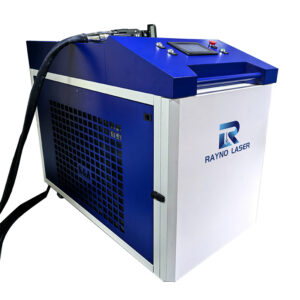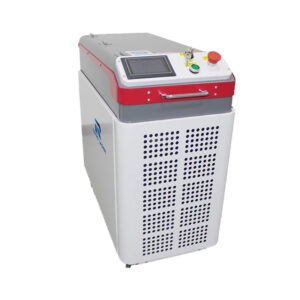
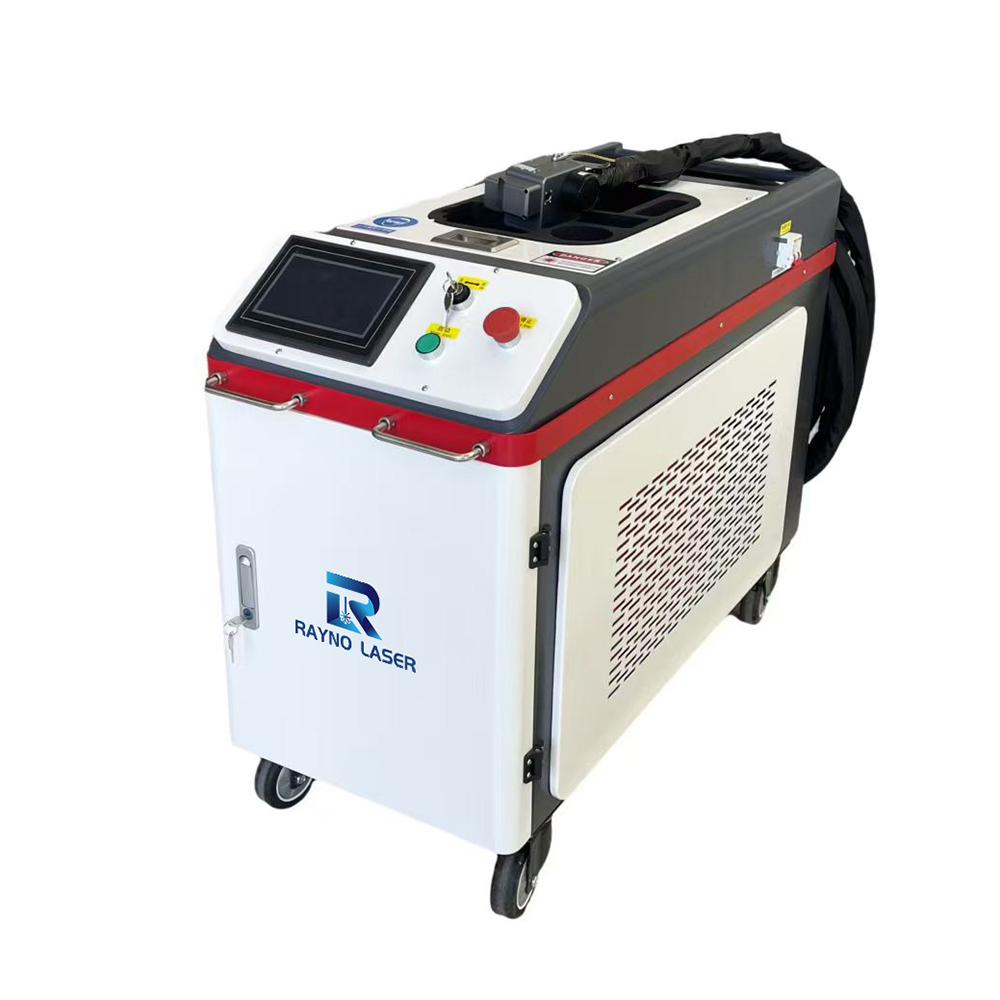
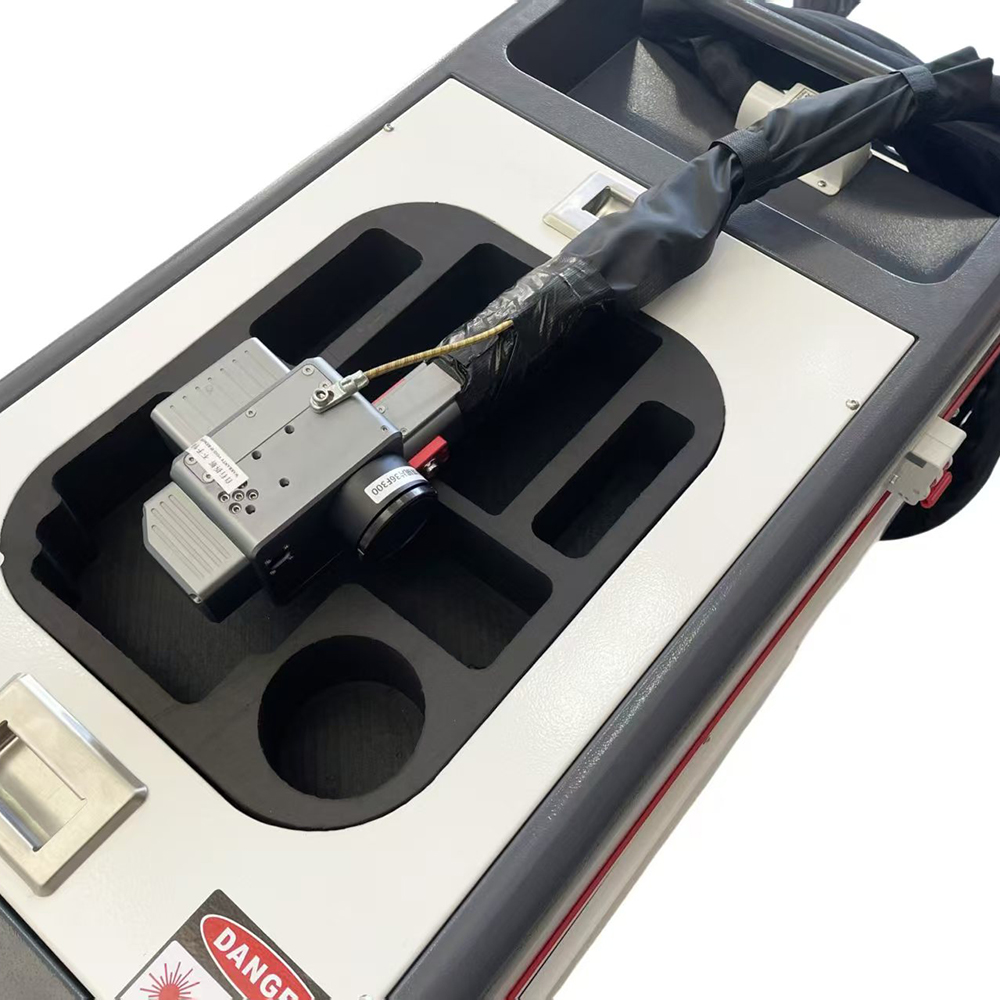
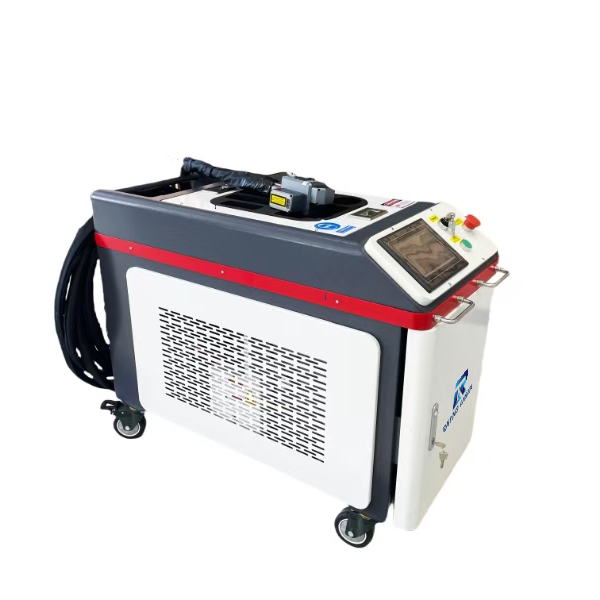
Explore the Rayno Laser RN-HC1000 1000W pulsed laser cleaning machine with Gaussian and flat-top beam options, adjustable scanning up to 360mm, and 15–50mJ pulse energy for industrial rust removal, paint stripping, and surface preparation.
When cleaning precision components, removing contaminants is only part of the job. Maintaining the original surface condition, dimensional accuracy, and fine details can be just as important.
The Rayno Laser RN-HC1000 1000W Pulsed Laser Cleaning Machine delivers laser energy in short pulses, allowing operators to control how energy interacts with the contamination layer. Compared with abrasive cleaning methods, pulsed laser cleaning avoids direct mechanical contact with the workpiece and can help reduce surface wear and excessive heat accumulation when the process is properly configured.
This makes pulsed laser cleaning a valuable solution for applications where cleaning effectiveness and substrate protection must be considered together.
Key benefits include:
Pulsed laser cleaning is not automatically damage-free under every condition. Excessive pulse energy, incorrect focus, or unsuitable scanning settings can still affect the substrate. For high-value or delicate components, sample testing is recommended to establish a suitable cleaning process.
| Category | Parameter | Specification |
| Electrical | Power supply | Single-phase AC220V ±10%, 50/60Hz |
| Total machine power | ≤6000W | |
| Environment | Operating temperature | 0°C–40°C |
| Relative humidity | ≤80% | |
| Laser | Average laser power | ≥1000W |
| Power instability | <5% | |
| Operating mode | Pulsed | |
| Pulse width | 30–500ns | |
| Maximum single-pulse energy | 1.5mj-15mJ–50mJ | |
| Power adjustment range | 0–100% | |
| Pulse frequency range | 1–3000/4000kHz | |
| Fiber cable length | 5m/10m | |
| Cooling | Cooling method | Water cooling |
| Cleaning | Scanning range | 0–360mm, adjustable. Or customized |
| Scanning modes | Supports 13 scan modes | |
| Scanning frequency | ≥300Hz | |
| Optics | Standard focal length | 300mm |
| Optional focal lengths | 150mm / 200mm / 250mm / 500mm / 600mm | |
| Machine | Approximate dimensions | 1092 × 458 × 796mm* |
| Approximate net weight | 135kg | |
| Packaging | Approximate package dimensions | 1210 × 650 × 1050mm |
| Approximate gross weight | 180kg | |
| Cleaning head | Weight | <1.5kg |
| Operation | Operating method | Handheld / automated |
Mold cleaning is an important application for pulsed laser cleaning machines. Injection molds, rubber molds, tire molds, and other industrial tooling can accumulate release agents, carbon deposits, polymer residues, rust, and other contaminants during production.
Traditional cleaning methods, including abrasive blasting, manual scraping, and chemical cleaning, may involve additional handling, consumables, or a risk of wearing precision surfaces. For molds with fine textures, narrow vents, detailed cavities, or polished areas, preserving the original surface condition is especially important.
The RN-HC1000 can be configured for suitable mold-cleaning applications, helping remove selected deposits without direct abrasive contact.
Depending on the mold material and contamination, pulsed laser cleaning may be used to remove:
1. Protect fine mold details
Mold cavities, textured surfaces, and narrow venting features may be difficult to clean using conventional tools. A properly configured laser cleaning process can target contaminated areas while reducing mechanical contact with the mold.
2. Reduce abrasive wear
Unlike sandblasting or manual abrasive treatment, laser cleaning does not rely on particles physically impacting the surface. This can help reduce cleaning-related wear when parameters are properly optimized.
3. Control the cleaning process
Adjustable laser power, pulse width, frequency, and scanning settings allow operators to develop suitable cleaning parameters for different deposits and mold surfaces.
4. Support mold maintenance efficiency
Laser cleaning may reduce the need for some manual scrubbing, abrasive consumables, or chemical-cleaning steps. Depending on the mold design and contamination, it may also be possible to clean selected areas without fully disassembling the tooling.
5. Help preserve surface quality
For molds where texture, finish, or dimensional precision matters, the goal is to remove unwanted buildup without unnecessarily modifying the underlying material. Proper parameter selection and sample testing are essential to achieving this balance.
The RN-HC1000’s 1000W average laser power makes it a high-power pulsed laser cleaning option for industrial applications. However, the most suitable configuration depends on the mold material, contaminant thickness, required cleaning precision, and acceptable surface change.
In addition to mold maintenance, the RN-HC1000 can be evaluated for other applications where controlled contaminant removal is required, including:
For these applications, the choice between Gaussian and flat-top beams is another important consideration.
A Gaussian beam concentrates more energy toward the center of the beam, while a flat-top beam provides a more uniform energy distribution across the effective spot. Depending on the application, either option may be suitable for achieving the required cleaning result.
For precision mold cleaning and other surface-sensitive applications, Rayno Laser recommends evaluating the beam configuration and cleaning parameters through sample testing before production use.
Pulsed laser cleaning can minimize the risk of surface damage when the laser parameters are properly matched to the mold material and contaminants. It avoids direct abrasive contact and allows controlled energy delivery. However, no laser cleaning process can guarantee zero surface change under all conditions, so testing is recommended for precision molds.
Pulsed laser cleaning offers controlled energy delivery, low heat accumulation under suitable conditions, and non-contact operation. These characteristics make it useful for cleaning mold cavities, textured surfaces, venting features, and other areas where mechanical wear or excessive heat should be minimized.
The RN-HC1000 can be evaluated for removing suitable residues, release agents, carbon deposits, rust, and other contamination from injection molds, rubber molds, and related tooling. The appropriate parameters depend on the mold material, contaminant type, and required surface finish. Application testing is recommended.
Not necessarily. Rated average power alone does not determine whether a laser cleaning machine is suitable for a precision application. Pulse energy, pulse width, frequency, beam profile, scanning settings, and the workpiece all influence the result. The process must be configured to deliver sufficient cleaning energy without exceeding the substrate’s tolerance.
Gaussian and flat-top beams have different energy distributions. The best option depends on the mold surface, contamination, desired cleaning uniformity, and substrate requirements. Rayno Laser can help evaluate the application through sample testing.
| Model | RN-HC1000 |
|---|---|
| Laser Power | 1000W |
| Laser Type | Pulsed Fiber Laser |
| Cooling Method | Built-in Water Chiller Cooling |
| Laser Cable Length | 10 m |
| Power Consumption | 6KW |
| Pulse Energy | 1.5mj, 5mj, 15mj, 50mj, 100mj |

Get additional product information or technical support. Our team is always available to provide you with the necessary guidance and solutions.
WhatsApp us
We will contact you within 24 hours, please pay attention to the email with the suffix “@raynolaser.com”.