
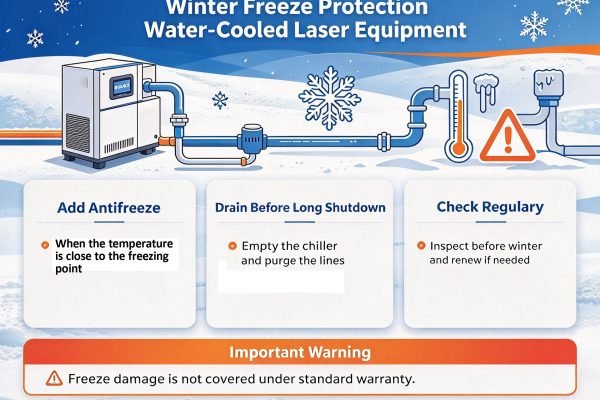
As temperatures drop, water-cooled laser equipment needs special attention. If coolant freezes inside a laser chiller, laser source, laser head, or connecting pipe, expansion may damage cooling channels, hoses, seals, and other components.
Freeze-related damage can cause coolant leaks, machine downtime, and costly repairs. Depending on the circumstances and the applicable warranty terms, damage caused by freezing or improper maintenance may not be covered.
This winter maintenance guide from Rayno Laser explains how to protect water-cooled laser equipment in cold environments, select compatible coolant, prepare machines for winter shutdown, and reduce the risk of freeze-related damage.
It applies to water-cooled fiber laser welding machines, laser cleaning machines, laser cutting machines, laser marking systems, UV laser systems, and other equipment with a liquid cooling circuit.
Important safety notice: Coolant requirements vary by laser source, chiller, and machine configuration. Before adding antifreeze, changing coolant, or draining the system, consult the manuals for your specific equipment and obtain confirmation from the manufacturer when necessary. This guide provides general maintenance information, not a substitute for model-specific instructions.
1. Which Laser Machines Need Winter Freeze Protection?
Freeze protection is relevant to water-cooled laser equipment that may be exposed to temperatures below the coolant’s freezing point.
Examples include:
- Fiber laser welding machines
- Pulsed and continuous-wave laser cleaning machines
- Fiber laser cutting machines
- Water-cooled laser marking machines
- Water-cooled UV laser systems
- Other laser machines using a chiller and liquid cooling circuit
Air-cooled laser machines do not have a laser coolant circuit that requires antifreeze. However, they must still be stored and operated within their specified temperature limits.
When should you prepare for freezing conditions?
Winter protection should be considered when:
- The workshop or storage area may fall below 0°C.
- The machine is shut down overnight in an unheated building.
- A power outage could stop the chiller and coolant circulation.
- The equipment will remain unused for an extended period.
- The machine will be transported or stored in a cold climate.
Even a machine normally operated indoors may be at risk if heating fails or the equipment is left in an unheated area.
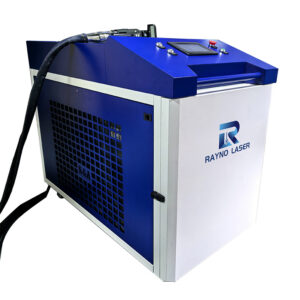

2. Choose a Winter Protection Method for Your Equipment
The appropriate method depends on whether the machine will continue operating, remain idle temporarily, or be stored for an extended period.
Option A: Use manufacturer-approved antifreeze coolant
An approved antifreeze coolant may be suitable when the machine needs to remain filled or operate in a cold environment.
However, not every antifreeze product is compatible with every laser source or chiller. Before using one, confirm:
- The coolant chemistry approved for the laser source and chiller
- Compatibility with hoses, seals, metals, and other wetted materials
- The permitted concentration range
- The required water quality for dilution
- The coolant’s rated freeze-protection temperature
- Whether antifreeze use is permitted under the equipment’s warranty and service requirements
Do not select coolant based only on the words “industrial antifreeze” or “laser coolant” on the label. Verify the product’s technical data and the equipment manufacturer’s requirements.
Option B: Drain the cooling circuit for extended storage
For a machine that will be shut down for a long period, draining may be the preferred storage method if the manufacturer provides an approved drainage procedure.
Draining the chiller reservoir alone may not remove coolant from the laser source, laser head, pump, filters, or connecting hoses. Some components may retain liquid in internal passages.
For this reason, complete drainage must follow the equipment-specific procedure. If the manufacturer does not provide clear instructions, contact technical support rather than improvising.
3. How to Select Antifreeze for a Laser Chiller
The correct coolant protects both the cooling system and the laser equipment.
Confirm the coolant chemistry first
Some systems may permit a propylene-glycol-based coolant formulated for industrial cooling applications. Other laser sources or chillers may specify a different coolant type or restrict the use of glycol products.
Therefore, Rayno Laser users should not assume that propylene glycol is universally approved. Check the laser source and chiller manuals or contact the equipment supplier to confirm the recommended product.
Avoid unapproved automotive antifreeze
Automotive antifreeze is formulated for vehicle cooling systems. Its additives may not be suitable for the materials, seals, or narrow cooling passages used in laser equipment.
Do not fill a laser chiller with automotive coolant unless the equipment manufacturer explicitly approves the exact product.
Do not use improvised alcohol mixtures
Do not substitute methanol, ethanol, or other improvised alcohol mixtures for an approved coolant. These products may introduce material compatibility, flammability, or equipment-safety risks.
Use the water specified by the manufacturer
When dilution is required, use the water type specified in the coolant and equipment documentation. Some laser cooling systems require distilled or deionized water, but the exact requirement must be confirmed for the particular machine.
Do not assume that tap water, mineral water, or any generic bottled water is suitable. Dissolved minerals and impurities may contribute to deposits or corrosion in some cooling systems.
4. Antifreeze Concentration and Freeze-Point Selection
There is no single antifreeze concentration that is suitable for every laser chiller.
The correct mixture depends on:
- The exact coolant formulation
- The lowest expected ambient temperature
- The coolant manufacturer’s freeze-protection data
- The laser source and chiller’s permitted concentration range
- The cooling system’s thermal and material requirements
Use the coolant manufacturer’s freeze-point chart
Some glycol-based coolant products provide freeze-protection information for different concentrations. The values can vary by formulation, so a generic ratio table should not be used as a universal laser equipment specification.
When selecting a mixture:
- Determine the lowest temperature the equipment may encounter, including during shutdown or storage.
- Check the coolant manufacturer’s freeze-point data for the exact product.
- Confirm that the proposed concentration is allowed by the laser source and chiller manufacturers.
- Select a suitable freeze-protection rating without exceeding the permitted concentration.
- If the environment may fall below the coolant’s rated protection, move the equipment to a suitable environment or use an approved storage procedure.
Why should you avoid excessive antifreeze concentration?
A higher antifreeze concentration does not automatically provide better equipment protection. Depending on the coolant, increased concentration may raise viscosity and reduce heat-transfer performance. It may also affect pump load and cooling efficiency.
Use only the concentration recommended for the actual coolant and equipment. Do not increase the concentration arbitrarily to compensate for an unsuitable storage environment.
For Rayno Laser customers: If you are unsure which coolant or concentration is compatible with your machine, provide the laser source model, chiller model, and expected minimum ambient temperature to technical support before making changes.
5. Coolant Inspection and Replacement
Antifreeze and other cooling fluids have a service life. Their condition may change through aging, contamination, or prolonged use.
The replacement interval should be determined by the coolant manufacturer’s service-life information and the equipment manufacturer’s maintenance requirements, rather than assuming that all laser coolant must be changed on the same schedule.
Before winter, inspect the coolant for:
- Discoloration
- Visible particles or deposits
- Unusual odor
- Signs of contamination
- A freeze-protection rating that no longer meets the expected conditions
Also inspect the chiller filter, coolant hoses, connectors, and accessible parts of the cooling circuit.
If seasonal antifreeze is used, confirm how the manufacturer recommends returning to the normal coolant after winter. Some systems may require draining and flushing before refilling. Do not mix a new coolant with an unknown or incompatible fluid.
6. Adding or Replacing Coolant: Follow the Equipment Procedure
The following checklist outlines general considerations. It is not a universal filling procedure; the specific machine and chiller manuals must take priority.
Before starting
- Shut down the laser and chiller using the specified procedure.
- Allow the equipment to cool.
- Confirm the existing coolant type.
- Verify the replacement coolant’s compatibility and permitted concentration.
- Check whether the manufacturer requires draining or flushing before refilling.
During coolant replacement
- Use the designated drain and fill points described in the manual.
- Prepare the coolant mixture according to the product’s instructions before filling, if premixing is required.
- Do not combine unknown fluids or different coolant products.
- Fill the system to the specified level.
- Follow the equipment’s procedure for circulation, bleeding, and checking coolant flow.
- Inspect the accessible connections for leaks.
- Do not enable the laser until the cooling system is operating normally and the required flow and temperature conditions are satisfied.
Record the maintenance
Keep a record of the coolant product, concentration, filling date, and any flushing or filter maintenance performed. This information can help with future servicing and troubleshooting.
7. Long-Term Shutdown and Winter Storage
If a water-cooled laser machine will remain idle in a cold environment, follow the manufacturer’s long-term storage procedure.
What should be checked before storage?
- Shut down and disconnect the equipment as directed by the manual.
- Identify all cooling circuits that require protection.
- Determine whether the manufacturer recommends approved antifreeze, drainage, or another storage method.
- If drainage is required, use the specified drain points and procedure.
- Confirm how the laser source, laser head, chiller, hoses, and other components should be handled.
- Protect coolant connections against dust and contamination as directed.
- Store the equipment within its specified environmental limits.
Is compressed air or nitrogen suitable for draining the cooling circuit?
Only if the equipment manufacturer explicitly provides an approved procedure.
Some laser sources contain delicate internal cooling passages. Applying excessive pressure or using an unsuitable connection may damage the cooling circuit, seals, or components.
Do not disconnect laser-source water lines or blow compressed air or nitrogen into internal passages based on a generic instruction. Contact Rayno Laser technical support if the correct drainage procedure is unclear.
Can antifreeze replace complete drainage?
Not in every situation. Antifreeze protects only within its rated temperature range and may not be approved for prolonged storage in a particular system. For long-term idle equipment, follow the storage instructions for the exact laser source and chiller.
8. Winter Maintenance Mistakes to Avoid
Mixing different coolant products
Different formulations may contain incompatible additives. Mixing them can affect coolant stability or material compatibility. Use only a confirmed compatible product and follow the approved replacement procedure.
Using automotive coolant without approval
Do not assume automotive antifreeze is suitable for a laser cooling circuit. Verify the exact product against the equipment manufacturer’s requirements.
Increasing concentration without checking the specification
Excessive concentration may impair cooling performance or exceed the system’s permitted coolant range.
Ignoring coolant condition
Discolored, contaminated, or out-of-life coolant should be assessed according to the product and equipment maintenance instructions.
Draining only the chiller reservoir
Coolant may remain in other parts of the system. Use the equipment-specific procedure to determine which components must be drained or otherwise protected.
Starting a machine with frozen or suspected-frozen coolant
Do not power on the laser or chiller if the cooling circuit may be frozen or blocked. Allow the equipment to thaw safely and have it inspected before restarting.
Assuming all freeze-related damage is covered by warranty
Warranty coverage depends on the terms applicable to the machine and the circumstances of the damage. Damage caused by freezing, unsuitable coolant, or failure to follow maintenance instructions may be excluded. Check the actual warranty documentation rather than relying on a general statement.
9. Frequently Asked Questions About Laser Machine Winter Protection
Does a laser machine in an indoor workshop need antifreeze?
If the machine and its entire cooling circuit are reliably kept within the manufacturer’s permitted temperature range, antifreeze may not be necessary. However, consider unexpected power outages, heating failures, cold storage, or transportation.
What should I do if the cooling system has already frozen?
Do not turn on the laser or chiller.
Move the equipment to an appropriate environment and allow it to thaw gradually. Do not use an open flame, heat gun, or direct high-temperature heating to accelerate thawing.
After thawing, the cooling circuit should be inspected for leaks, blockages, damaged hoses, seals, and other possible freeze-related damage. Contact qualified service personnel before restarting the equipment.
Can I use the same antifreeze for every Rayno Laser machine?
Not necessarily. Coolant requirements may differ by laser source, chiller, and machine configuration. Confirm the approved coolant and concentration for the specific equipment.
Is a 30% antifreeze mixture always sufficient?
No. Freeze protection depends on the exact coolant formulation and the actual concentration. Check the product’s technical data and confirm that the mixture is permitted by the laser and chiller manufacturers.
Can I leave antifreeze in the machine all year?
That depends on the coolant and the equipment manufacturer’s requirements. Check the coolant’s service life and whether year-round use is approved. Follow the specified procedure when changing back to the normal coolant.
Do air-cooled laser machines need antifreeze?
Air-cooled machines do not have a liquid laser cooling circuit that requires antifreeze. They must still be stored and operated within their specified temperature and environmental limits.
10. Prepare Your Rayno Laser Machine Before Winter
Winter freeze protection is an important part of preventive maintenance for water-cooled laser equipment. The correct procedure depends on the machine, laser source, chiller, coolant, and expected storage conditions.
Before temperatures drop:
- Identify whether your equipment is water-cooled.
- Check the lowest expected temperature at the machine’s location.
- Review the laser source and chiller manuals.
- Confirm the approved coolant and concentration, if antifreeze is required.
- Inspect coolant condition, filters, hoses, and connections.
- Plan an approved storage or drainage procedure if the machine will be idle.
If you are unsure which coolant is compatible with your Rayno Laser machine, what freeze-protection rating is appropriate, or how to prepare the cooling circuit for long-term storage, contact Rayno Laser technical support.
Please provide your machine model, laser source model, chiller model, and expected minimum ambient temperature. Our team can help you identify the equipment-specific documentation and maintenance requirements.
Protecting your laser cooling system before winter can help reduce the risk of freeze-related damage and avoid preventable production downtime.