
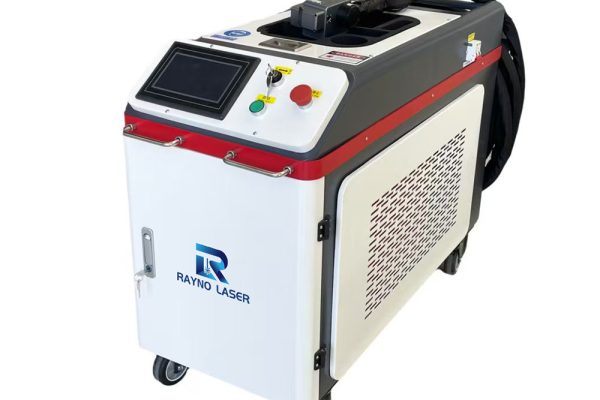
Is a 1000W pulsed laser cleaning machine twice as fast as a 500W model?
This is a common question for manufacturers, metal fabricators, maintenance contractors, and industrial buyers comparing laser cleaning equipment.
Both 500W and 1000W pulsed laser cleaning machines can remove rust, paint, oxide layers, and other surface contaminants. However, when cleaning large metal components or handling high-volume projects, the difference in processing efficiency can directly affect labor costs, production schedules, and overall return on investment.
To help customers make a more informed decision, Rayno Laser conducted a side-by-side cleaning test using a 500W pulsed laser cleaning machine and a 1000W pulsed laser cleaning machine under the same test conditions.
The key finding: In our controlled comparison test, the 1000W pulsed laser cleaning machine achieved approximately twice the cleaning efficiency of the 500W model.
The comparison video shows the actual cleaning process, allowing buyers to evaluate the difference in cleaning speed and results rather than relying on laser power specifications alone.
Contact Rayno Laser to request arrange a cleaning test with your own workpieces.
1. How Did We Compare the 500W and 1000W Laser Cleaning Machines?
Comparing laser cleaning machines based only on their rated power does not provide enough information to determine their actual performance. Cleaning speed depends on several variables, including the substrate, coating type, coating thickness, laser parameters, and scanning configuration.
For this reason, Rayno Laser used a controlled side-by-side test to compare the two machines under consistent conditions.
Test setup
| Test Item | Test Conditions |
|---|---|
| Equipment | 500W pulsed laser cleaning machine and 1000W pulsed laser cleaning machine |
| Laser source | Same series and same pulsed laser source model, with different rated power |
| Substrate | Remove paint from wood workpieces |
| Contamination | Rust and paint coatings |
| Field lens | Same field lens |
| Pulse energy setting | Same selected setting |
| Working distance | Same working distance |
| Auxiliary gas | Same auxiliary gas conditions |
| Test method | Clean a fixed workpiece area and record the time required |
| Performance evaluation | Compare cleaning time and cleaning area per unit of time |
The purpose of this test was to minimize differences unrelated to laser power so that the cleaning performance of the two machines could be compared more fairly.
The complete test video records the process and provides a practical reference for customers evaluating a 500W or 1000W pulsed laser cleaner for their own applications.
2. Key Test Results: 500W vs. 1000W Pulsed Laser Cleaning
The 1000W model achieved approximately 2× cleaning efficiency in our test
Under the specific conditions used in this comparison, the 1000W pulsed laser cleaning machine achieved approximately twice the cleaning efficiency of the 500W model.
This means that, for the tested workpiece and cleaning conditions, the higher-power machine could clean a comparable area in substantially less time.
For businesses handling large quantities of rusted parts, painted metal components, or industrial maintenance projects, this difference can be significant.
Higher cleaning efficiency may help businesses:
- Complete large-area cleaning projects faster.
- Increase daily processing capacity.
- Reduce the time spent on repetitive cleaning operations.
- Improve delivery efficiency for contract cleaning work.
- Handle larger workloads without extending working hours proportionally.
However, the 2× result should be understood as the outcome of this particular controlled test, not a universal performance guarantee for every cleaning application.
Does the 1000W machine clean better than the 500W machine?
Both machines can remove rust, paint, and other suitable surface contaminants when configured correctly.
The main difference demonstrated in this test was cleaning efficiency, rather than an assumption that the 1000W machine always produces a better surface finish.
Cleaning quality depends on the required removal depth, coating characteristics, substrate condition, and laser parameters. A 500W machine can be entirely adequate for many applications, while a 1000W machine may offer a more productive solution when throughput is the priority.
| Comparison | 500W Pulsed Laser Cleaner | 1000W Pulsed Laser Cleaner |
|---|---|---|
| Rated average laser power | 500W | 1000W |
| Rust removal | Suitable for many industrial cleaning tasks | Suitable for many industrial cleaning tasks with higher throughput potential |
| Paint removal | Suitable for appropriate coatings and workpieces | Can be advantageous for higher-volume paint removal |
| Large-area cleaning | Suitable, depending on required output | Often a stronger choice when productivity is critical |
| Small workpieces and localized cleaning | Can be a practical, cost-conscious option | May offer more capacity than the application requires |
| Typical buying priority | Investment cost and workload requirements | Cleaning productivity and project capacity |
The right machine should be selected according to the actual cleaning task, not rated power alone.
3. Why Doesn’t Doubling Laser Power Always Double Cleaning Speed?
Although the 1000W model achieved approximately twice the cleaning efficiency in our test, laser cleaning speed does not always increase in direct proportion to laser power.
Different contaminants respond differently to laser energy.
For example, a thin rust layer may be removed relatively quickly with a 500W pulsed laser cleaning machine. Increasing power to 1000W may improve productivity, but the efficiency gain will depend on the material and process settings.
Thick paint, multilayer coatings, strongly adhered contaminants, and uneven corrosion may require different pulse parameters, multiple passes, or a different scanning strategy.
The following factors can affect the actual cleaning speed:
1. Coating thickness and adhesion
Thin coatings and loose rust generally require less processing than thick, strongly bonded paint or heavy corrosion.
2. Substrate material
Different metals absorb and respond to laser energy differently. A suitable process for carbon steel may not produce the same results on stainless steel, aluminum, or other materials.
3. Pulse energy and pulse parameters
Average laser power is only one part of the process. Pulse energy, pulse width, repetition frequency, and scanning speed also influence how effectively the contamination is removed.
4. Scanning width and focal configuration
The field lens, effective scanning width, working distance, and scan pattern affect the area treated and the energy delivered to the surface.
5. Required cleaning result
Removing loose rust is different from completely stripping several layers of paint or preparing a surface to meet a specific finishing requirement. More thorough cleaning may require additional passes and reduce the area cleaned per hour.
For these reasons, Rayno Laser recommends testing representative workpieces before estimating production capacity or choosing a machine for a large project.
4. Which Should You Choose: A 500W or 1000W Pulsed Laser Cleaning Machine?
The best choice depends on your daily workload, cleaning area, contamination type, budget, and productivity targets.
When should you choose a 1000W pulsed laser cleaning machine?
A 1000W pulsed laser cleaner is worth considering if your business prioritizes higher throughput.
Typical applications include:
- Large-area industrial rust removal.
- High-volume paint stripping from metal components.
- Batch cleaning of industrial parts.
- Maintenance projects involving multiple workpieces.
- Contract cleaning services with tight delivery schedules.
- Production environments where cleaning time affects overall throughput.
For businesses that clean large areas every day, the productivity advantage demonstrated in Rayno Laser’s comparison test may justify the higher initial equipment investment.
The best way to evaluate this decision is to compare the machine’s actual cleaning capacity against your daily workload and labor costs.
When is a 500W pulsed laser cleaning machine the better choice?
A 500W pulsed laser cleaning machine can be a practical option when the workload does not require the additional capacity of a 1000W system.
Consider a 500W model for:
- Small and medium-sized workpieces.
- Localized rust or paint removal.
- Small-batch production.
- Routine equipment maintenance.
- Applications where precision and controlled cleaning are priorities.
- Businesses seeking a lower initial investment.
A 500W machine is not necessarily the inferior choice. If your cleaning jobs are relatively small or infrequent, paying for additional capacity may not deliver enough operational value to justify the extra cost.
For precision applications, including selected mold-cleaning tasks, the appropriate power level should be determined by the substrate, contamination, surface-finish requirements, and sample-test results.
A practical selection guide
| Your Main Requirement | Suggested Starting Point |
|---|---|
| Higher daily cleaning volume | Evaluate the 1000W model |
| Large-area rust and paint removal | Evaluate the 1000W model |
| Small workpieces and localized cleaning | Evaluate the 500W model |
| Lower initial investment | Evaluate the 500W model |
| Difficult or thick coatings | Test both models on the actual coating |
| Precision or substrate-sensitive cleaning | Compare cleaning results and surface condition before selecting |
These are starting recommendations, not absolute rules. Actual performance should be confirmed using representative workpieces.
5. Compare the Results Before You Buy
A product specification sheet can tell you the rated laser power, pulse parameters, scanning range, and other technical details. It cannot fully predict how quickly a particular coating will be removed from your workpiece.
That is why Rayno Laser uses application testing to help customers select suitable laser cleaning equipment.
Request the 500W vs. 1000W comparison video
If you are comparing a 500W pulsed laser cleaning machine with a 1000W model, the complete Rayno Laser test video can help you assess the difference under the conditions used in our comparison.
You can observe the cleaning process and discuss how the results relate to your application.
Send your samples for a cleaning test
If your workpieces have a different coating, rust level, substrate material, or surface-finish requirement, we recommend testing them directly.
Rayno Laser can help evaluate:
- Suitable laser power.
- Pulse energy and other laser parameters.
- Appropriate field lens configuration.
- Cleaning speed and number of passes.
- Cleaning results and substrate condition.
Sample testing provides a more reliable basis for choosing a laser cleaner than relying on rated power alone.
Related Products

6. Frequently Asked Questions
Is a 1000W pulsed laser cleaning machine twice as fast as a 500W machine?
In Rayno Laser’s controlled comparison test, the 1000W model achieved approximately twice the cleaning efficiency of the 500W model under the specific test conditions. Actual results may vary depending on the substrate, coating thickness, contamination, laser parameters, and required cleaning quality.
Does higher laser power always mean better cleaning results?
No. Higher average power can increase cleaning capacity, but the final result also depends on pulse energy, pulse width, frequency, scanning parameters, and the material being cleaned. Excessive or unsuitable laser energy can damage the substrate. The process should be configured for the specific application.
Can both 500W and 1000W pulsed laser cleaners remove rust and paint?
Yes. Both power levels can be suitable for rust removal and paint stripping on compatible workpieces. The most suitable machine depends on the contamination, coating thickness, required cleaning speed, and desired surface finish.
Does coating thickness affect the efficiency difference between 500W and 1000W machines?
Yes. Thin rust, heavy corrosion, single-layer paint, and thick multilayer coatings can behave differently during laser cleaning. The efficiency ratio between the two machines may change with the application, so the result from one test should not be assumed to apply to every coating.
Is a 500W pulsed laser cleaner more portable than a 1000W model?
Not necessarily. Portability depends on the complete machine design, including the laser source, cooling system, enclosure, cleaning head, and overall weight. Compare the actual dimensions and weight specifications of the two models rather than using laser power alone to judge portability.
How can I determine which laser cleaning machine is right for my business?
Start by identifying the substrate, contamination type, coating thickness, required surface condition, daily cleaning area, and target production time. Rayno Laser can use these details and sample-test results to help recommend an appropriate power level and configuration.
Conclusion: Choose Laser Power Based on Real Cleaning Performance
Both 500W and 1000W pulsed laser cleaning machines have a place in industrial surface cleaning.
A 500W machine may offer a suitable balance of investment and performance for smaller jobs, localized cleaning, and moderate workloads. A 1000W pulsed laser cleaning machine is worth considering when large cleaning areas, batch processing, and higher daily throughput are the main priorities.
In Rayno Laser’s side-by-side comparison, the 1000W model achieved approximately 2× the cleaning efficiency of the 500W model under the tested conditions. This result demonstrates the potential productivity advantage of moving to a higher-power pulsed laser cleaner, while also highlighting the importance of testing the actual application.
Want to see the difference for yourself?
Contact Rayno Laser to request a sample cleaning test, or get a recommendation based on your substrate and coating requirements.
Let us help you choose a laser cleaning machine that matches your cleaning performance targets, production workload, and budget.